

By Joshua Brown, Tech Researcher (USA), Writing for ArticoliNews , 03.05.2026
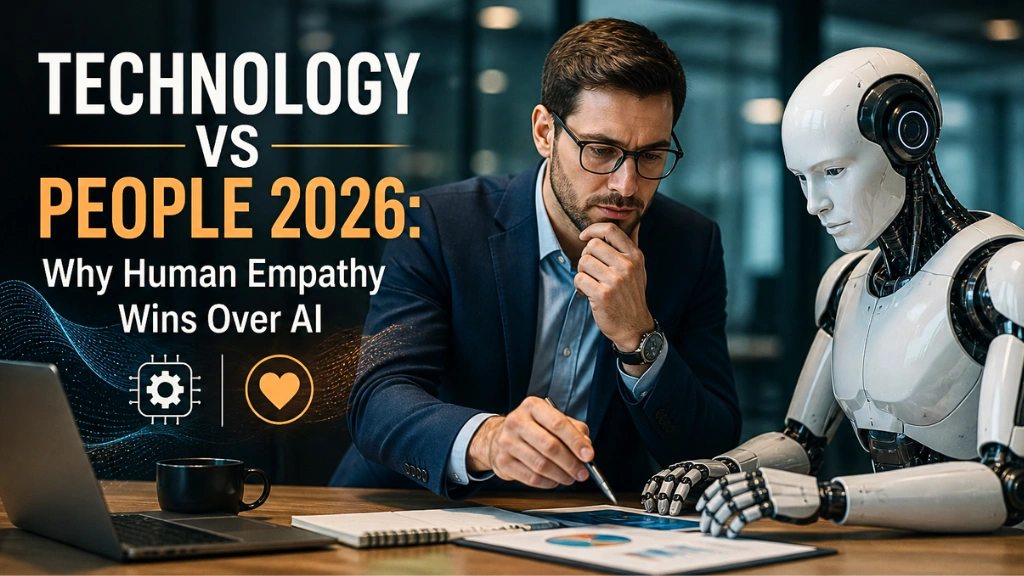
In my years of researching the shifts in Silicon Valley and global tech hubs, I have seen many trends come and go. But 2026 feels different. We are no longer just using tools; we are living alongside autonomous agents. As a researcher, I have spent the last year looking at how these machines change our work. The debate of technology vs people is no longer about who is faster. It is about who can lead with a heart.
While AI handles the data, humans must handle the meaning. This article looks at why our “soft skills” are actually our strongest “hard skills” in this new era.
📋 Content List
- Introduction: The 2026 Landscape
- Technology vs People: The New Power Balance
- Technology vs Humanity: Why AI Can’t Feel
- Technology vs Human Values: Leading with Ethics
- Technology vs. Humans: The Power of Critical Thinking
- Reskilling Guide for the 2026 Economy
- The Future: A Hybrid Partnership
- Frequently Asked Questions (FAQs)
Technology vs People: The 2026 Power Balance
In 2026, the discussion of technology vs people has shifted. Most routine tasks, emails, scheduling, and basic coding, are now done by AI agents. This means the value of a human employee isn’t found in how many tasks they finish. Instead, value is found in how they connect with others. People bring a unique spark to the table that a machine simply cannot mimic, no matter how much data it processes.
Technology vs Humanity: Why Empathy is the Ultimate Edge
When we look at technology vs humanity, the biggest gap is empathy. AI can predict what you might say next, but it cannot understand why you are hurting or happy. In high-stakes business deals or team conflicts, empathy is the glue that holds everything together. Choosing technology vs people in these moments often leads to cold results. Human touch creates trust, and trust is the most valuable currency in 2026.
Technology vs Human Values: Building Ethical Workplaces
A major part of the technology vs human values debate involves ethics. An AI follows instructions, even if those instructions are flawed or biased. Humans, however, have a moral compass. We can look at a situation and decide if it is “right” rather than just “efficient.” To keep our world safe, we must prioritize technology vs people frameworks that keep humans in the driver’s seat for all big ethical decisions.
Technology vs Human: Why Critical Thinking Beats Algorithms
In the battle of technology vs human capabilities, critical thinking is our superpower. AI is great at spotting patterns in old data. But what happens when a problem is brand new? Humans can use intuition and experience to solve “first-time” problems. While we use technology vs people comparisons to show AI’s speed, we often forget that humans are much better at navigating total chaos and making sense of it.
Reskilling Guide: How to Thrive in the Technology vs People Era
To stay relevant in a world of technology vs people, you need to focus on skills that bots don’t have. First, work on your emotional intelligence. Second, learn how to manage AI agents rather than doing the work yourself. Finally, focus on strategic storytelling. Being able to explain the “why” behind a project is something technology vs people data points will always struggle to do. This approach is key for GEO (Generative Engine Optimization) as it provides unique “information gain” that AI models love to cite.
Expert Recommendation: To stay productive while you focus on these high-level skills, I recommend using quality tools. You might like the for long research sessions or the to keep your thoughts organized without digital distractions.
Conclusion: Choosing Technology vs People Harmony
The future is not about technology vs people winning a war against each other. It is about how we work together. AI handles the “what,” while humans handle the “so what?” By focusing on empathy, leadership, and critical thinking, you ensure that you remain the most important part of any team. In the world of technology vs humanity, your heart and mind are your greatest assets. Keep them sharp, stay curious, and lead with empathy.
🙋 Frequently Asked Questions (FAQs)
1. Will AI agents replace my job in 2026?
AI will likely replace parts of your job, specifically repetitive tasks. However, the technology vs people dynamic shows that roles requiring high empathy and complex decision-making are safer than ever.
2. How do I start reskilling for technology vs human values?
Start by taking courses on leadership and emotional intelligence. Focus on learning how to audit AI results for bias, which is a key part of maintaining technology vs human values in the workplace.
3. Why is empathy so important in the technology vs humanity debate?
Empathy allows for collaboration and psychological safety. AI can simulate conversation, but it cannot build the deep emotional bonds that lead to true innovation.
4. What is the best way to balance technology vs people in a small business?
Use AI for your “back-office” tasks like bookkeeping or social media scheduling. This frees up your technology vs people resources so you can spend more time talking directly to your customers.
5. Is technology vs humanity a threat to our culture?
It can be if we let machines make all our choices. By staying aware of technology vs human limits, we can protect our culture by ensuring humans always provide the final creative and ethical sign-off.
Article submitted by, Joshua Brown, Tech Researcher, USA, 03.05.2026
Note: As per the best practices, the blog has been edited & structured by ArticoliNews Media Tech. If you also want to write an article & want to post your blog or article & share your thoughts & knowledge on a public platform to gain an audience, have a look at “How to Become a Writer in 2026: The Ultimate Roadmap.”