

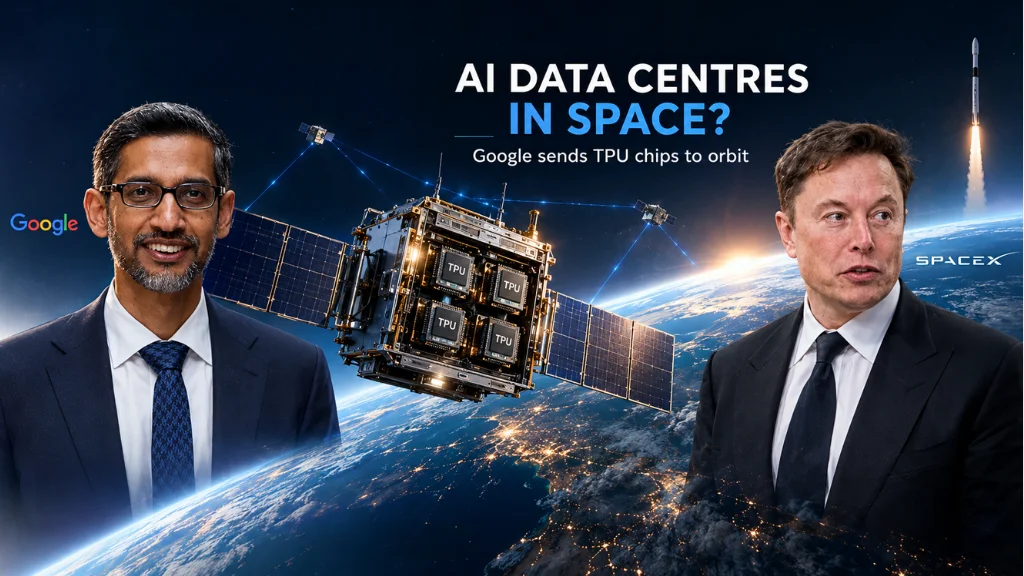
AI data center in space for real? What did Elon Musk react to on this? Let’s see…
Space is no longer just about rockets and astronauts. Google is officially testing whether artificial intelligence hardware can operate beyond Earth’s atmosphere. As part of its long-term research initiative called Project Suncatcher, the company is sending a prototype satellite carrying advanced Tensor Processing Units (TPUs) into low Earth orbit. Launched in partnership with Planet Labs on a SpaceX rideshare mission, this test marks an early step toward exploring whether an AI data center in space can ease the heavy power and water demands placed on terrestrial grids.
- Project Suncatcher Launch: Google’s prototype satellite evaluates how commercial AI hardware survives launch vibrations, space radiation, and thermal extremes.
- Energy and Cooling: Operating in low Earth orbit allows satellites to harness continuous sunlight for solar power, though managing heat without airflow remains an engineering hurdle.
- Elon Musk’s Stance: Tech leader Elon Musk reacted positively to the move, noting that orbital infrastructure could eventually handle a major share of global computing.
- Future Roadmap: Following this initial trial, Google plans a follow-up two-satellite mission in 2027 to test high-speed laser links and satellite clustering.
👉 Why this matters: Terrestrial server farms consume massive amounts of electricity and water resources. Developing a viable AI data center in space could open up a new pathway to scale computing capacity without straining local environments on Earth.
Note:  Written and summarized by our editorial team using human review & a bit of AI assistance. Edited & Approved by Debraj Paul, Founder of Articolinews Media-Tech.