

By Chiraag Talukdar, Writer & Culture Enthusiast, Mumbai, 19.10.2026
Living in Mumbai, I get a front-row seat to how India transforms every autumn. One day you are stepping out to catch a high-energy Garba circle in Ghatkopar, and the next evening you are walking into an ornate themed pandal in Powai with the sound of dhak drums vibrating through the air.
While the festival goes by different names across our states, it all comes back to one core truth: honoring the divine feminine power, Shakti. If you are looking to plan your travels or simply understand how your neighbours celebrate, this complete guide to Navratri and Durga Puja 2026 breaks down everything from dates to regional rituals.
📋 Content List
- Introduction: Unity in Diversity
- Timelines & Important Dates for 2026
- The Historical & Spiritual Core: Durga’s Victory vs. Rama’s Triumph
- Navratri Mata 9 Roops: The Nine Divine Manifestations
- Regional Navratri Celebrations India: State-by-State Guide
- Kolkata Durga Puja vs Gujarat Garba: Understanding the Vibe
- How India Celebrates Navratri: Fasting, Feasting, and Travel Tips
- Conclusion: Celebrating the Divine Feminine Together
- Frequently Asked Questions (FAQs)
Introduction: Unity in Diversity During Navratri and Durga Puja 2026
Every autumn, India experiences a festive wave unlike anything else in the world. What makes Navratri and Durga Puja 2026 so special is that while the underlying faith is the same, the cultural expression changes every few hundred kilometers. In the West, it’s nine nights of continuous dance. In the East, it’s a giant street-art museum. In the North, it’s a period of deep fasting and quiet devotion. Understanding how India celebrates Navratri reveals our country’s incredible ability to hold diverse customs under one grand umbrella.
Timelines & Important Dates for Navratri and Durga Puja 2026
Planning your holidays or pandal visits? Grounding your festive calendar with accurate dates is essential:
- Sharad Navratri 2026: Starts on Sunday, October 11, and ends on Tuesday, October 20, 2026.
- Mahalaya: Saturday, October 10, 2026 (marking the arrival of Goddess Durga).
- Durga Puja 2026: Key public pandal days run from Maha Shashthi on Friday, October 16, to Vijaya Dashami on Wednesday, October 21, 2026.
- Maha Ashtami & Sandhi Puja: Monday, October 19, 2026.
- Dussehra / Vijayadashami: Celebrated across North, West, and South India on October 20–21, 2026.
The Historical & Spiritual Core: Durga’s Victory vs. Rama’s Triumph
When diving into Durga Puja 2026 traditions, it’s helpful to look at the dual storytelling that powers this season.
In Eastern and Central India, the story centers on Goddess Durga riding a lion to defeat the demon Mahishasura after a ten-day battle, restoring balance to the universe. In Northern and Western states, the focus shifts to Lord Rama’s worship of Goddess Durga before defeating Ravana on Vijayadashami. Both narratives honor the triumph of light over dark, but they shape very different rituals on the ground.
Navratri Mata 9 Roops: Understanding the Nine Forms
A central element of regional Navratri celebrations in India is the devotion to the Navratri Mata, 9 roops (the nine forms of Goddess Durga, known as Navadurga):
- Maa Shailaputri (Day 1): Daughter of the mountains, representing strength and firm beginnings.
- Maa Brahmacharini (Day 2): Symbolizing penance, discipline, and devotion.
- Maa Chandraghanta (Day 3): The warrior form riding a tiger, representing bravery and peace.
- Maa Kushmanda (Day 4): The creator of the cosmos, bringing light and energy.
- Maa Skandamata (Day 5): The protective mother form carrying Lord Kartikeya.
- Maa Katyayani (Day 6): The fierce warrior goddess born to destroy evil forces.
- Maa Kalaratri (Day 7): The darkest, most powerful form that eliminates fear and negativity.
- Maa Mahagauri (Day 8): Representing purity, calm, and grace, worshipped on Maha Ashtami.
- Maa Siddhidatri (Day 9): The bestower of spiritual power, knowledge, and fulfillment.
Regional Navratri Celebrations India: A State-by-State Guide
West India (Gujarat & Maharashtra)
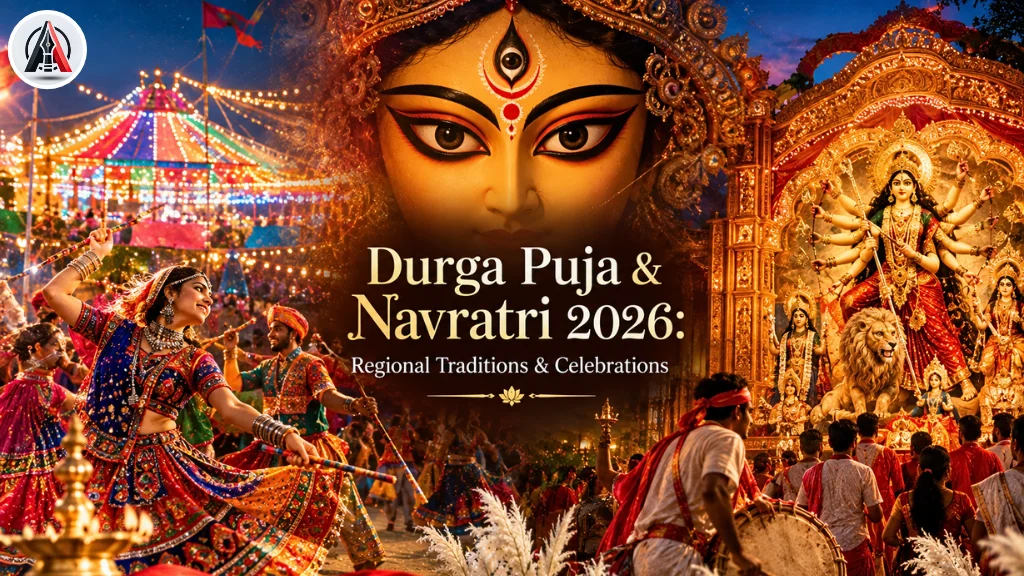
In Gujarat and parts of Maharashtra, Navratri and Durga Puja 2026 are defined by community bonding and dance. The center of worship is the Garbha Deep (an earthen lamp placed inside a perforated pot), around which women and men perform Garba and Dandiya Raas in circular formations.
East India (West Bengal, Assam, Tripura)
If you travel east, Durga Puja in West Bengal is less about fasting and more about public art, feasting, and community gathering. Neighborhoods in Kolkata build elaborate pandals (temporary structures) housing handcrafted idols. Key moments include the fragrant incense-and-drum dance known as Dhunuchi Naach during evening Aarti and the emotional Sindoor Khela on Dashami.
North India (Delhi, Uttar Pradesh, Punjab)
Here, the atmosphere during Navratri and Durga Puja 2026 revolves around solemn fasting, evening Ramlila dramatic performances, and home pujas. Families fast for eight or nine days, avoiding onion, garlic, and grains. The festival culminates in Kanya Pujan on Ashtami or Navami, where young girls are invited home, worshipped as forms of the Goddess, and served a traditional meal of halwa, puri, and chana.
South India (Tamil Nadu, Karnataka, Andhra Pradesh)
In Tamil Nadu, households set up Bommai Golu, a multi-tiered wooden step display decorated with handcrafted clay dolls depicting mythological stories and everyday life. Neighbors visit each other to sing devotional songs and exchange gifts. In Mysuru (Karnataka), the famous 10-day Mysuru Dasara features a grandly illuminated Royal Palace and a procession carrying Goddess Chamundeshwari atop a gold-bedecked elephant.
Traveler’s Recommendation: If you plan on attending night-long Garba events or doing pandal walks across Kolkata, comfortable footwear is a must. You can check out a supportive Padded Festive Ethnic Footwear option to keep your feet pain-free. Also, carrying a Portable Handheld Fan helps beat the evening festive humidity!
Kolkata Durga Puja vs Gujarat Garba: Comparing the Vibes
People often ask me: “Why is Durga Puja celebrated so differently in Bengal compared to Gujarat?” It comes down to cultural intent:
| Feature | Kolkata Durga Puja | Gujarat Garba |
| Primary Focus | Welcoming Goddess Durga home as a beloved daughter | Honoring divine energy through rhythmic devotional dance |
| Food Culture | Feasting (includes fish, mutton, bhog, and sweets) | Strict vegetarian fasting or Sattvik diet |
| Key Attraction | Mega-scale temporary art pandals and street food stalls | Night-long Garba circles in colorful Chaniya Cholis |
| Community Vibe | Neighborhood walking tours, late-night pandal hopping | High-energy music, traditional drums (Dhol), and footwork |
Both expressions during Navratri and Durga Puja 2026 show how our heritage embraces joy in totally different ways!
How India Celebrates Navratri: Fasting, Feasting, and Etiquette
If you are joining in the celebrations for Navratri and Durga Puja 2026, keep these simple cultural tips in mind:
- Fasting Rules (Vrat): If practicing North Indian fasting, meals usually consist of Sabudana (tapioca), Kuttu (buckwheat flour), Sama rice, rock salt (sendha namak), and milk products.
- Dress Code: Bright traditional attire is standard across all regions. In Gujarat, men wear Kediyu, and women wear multi-colored Chaniya Cholis. In Bengal, women wear traditional red-and-white Garod sarees, while men wear kurta-pyjamas or dhotis.
- Pandal Etiquette: When visiting pandals for Durga Puja in West Bengal, always remove shoes where designated and ask before taking flash photography near the main deity.
Conclusion: Celebrating the Divine Feminine Together
Whether you are spinning in a Garba ring in Ahmedabad, tasting community bhog in a Kolkata street, or sitting quietly for Kanya Pujan at home, Navratri and Durga Puja 2026 remind us of our shared roots. The beauty of how India celebrates Navratri lies in its diversity, proving that no matter our language or regional food habits, the spirit of devotion brings us all together every single autumn.
🙋 Frequently Asked Questions (FAQs)
1. What are the main dates for Navratri and Durga Puja 2026?
Sharad Navratri 2026 runs from October 11 to October 20. The core public days for Durga Puja in West Bengal take place from Maha Shashthi on October 16 to Vijaya Dashami on October 21, 2026.
2. Why is food so different in Kolkata Durga Puja vs Gujarat Garba?
In Gujarat, Navratri is a period of Sattvik purification and fasting. In Bengal, Durga is treated as a visiting daughter returning home to her parents’ house, so families celebrate by cooking her favorite grand meals, including fish and meat delicacies.
3. What is the significance of the Navratri Mata 9 roops?
Each of the Navratri Mata’s 9 roops represents a distinct stage of divine energy, cosmic creation, protective strength, and grace. Devotees pray to a specific form on each night of the festival for health, courage, and prosperity.
4. What is Dhunuchi Naach during Durga Puja 2026 traditions?
Dhunuchi Naach is a traditional devotional dance performed during evening Aarti in Eastern India. Dancers hold clay pots filled with burning coconut husk and frankincense (dhuno), swaying to the rhythm of dhak drums in honor of Goddess Durga.
5. How do I participate in regional Navratri celebrations in India as a visitor?
Most public events, like Kolkata’s pandal hopping or open ground Garba events in Mumbai and Gujarat, welcome respectful visitors! Just dress in simple ethnic wear, respect local traditions, and check ticket/pass requirements ahead of time for major venues.
Article submitted by, Chiraag Talukdar, Writer & Culture Enthusiast, Mumbai, 19.10.2026
Note: As per the best practices, the blog has been edited & structured by ArticoliNews Media Tech. If you also want to write an article & want to post your blog or article & share your thoughts & knowledge on a public platform to gain an audience, have a look at “How to Become a Writer in 2026: The Ultimate Roadmap.”