

By Digvijay Basu, Social Impact Analyst & Writer at Articoli News. 20.12.2025. Writing on the Home For Homeless campaign on social media.
Introduction: The Invisible Crisis
In the rapidly growing urban and rural landscapes of India, the “Housing for All” mission remains a monumental challenge. Millions of people in rural and semi-urban India still live in “katcha” houses, shacks made of mud, plastic sheets, and tin that are blown away by one strong monsoon wind.
While government schemes, such as Pradhan Mantri Awas Yojana (PMAY), have set ambitious targets, the gap is often filled by grassroots community efforts and non-governmental initiatives. But the truth is that the government can’t do it alone. This is where community initiatives come in. Today one such campaign currently gaining traction on social media is the “Home for Homeless” initiative by Saint Gurmeet Ram Rahim and the volunteers of Dera Sacha Sauda (DSS). Today, we look at how community-driven housing models are providing a blueprint for social impact.
But how does it actually work on the ground? And can this model really help solve India’s housing problem?
Table of Contents
- The Reality of Being Homeless in Rural India
- How the “Home for Homeless” Campaign Works
- On-Ground Impact: Stories from the Field
- A Balanced view: Community vs. Government
- Conclusion:
- Frequently Asked Questions (FAQs)
I. The Reality of Being Homeless in Rural India
Before looking at solutions, we must understand the problem.
According to various housing reports, India faces a shortage of nearly 18.78 million houses in urban areas alone. Being homeless in a village isn’t always about sleeping on a sidewalk. Often, it means living in a hut that offers no protection from heatwaves, biting cold, or heavy rain. For an elderly widow with no children to support her or a family where the breadwinner is disabled, building a permanent (pucca) house is a dream they can never afford.
Most people don’t realize that building a small house in a village costs between ₹1.5 lakh to ₹3 lakh. For someone earning ₹200 a day in manual labor, that is a lifetime of debt.
II. How the “Home for Homeless” Campaign Works
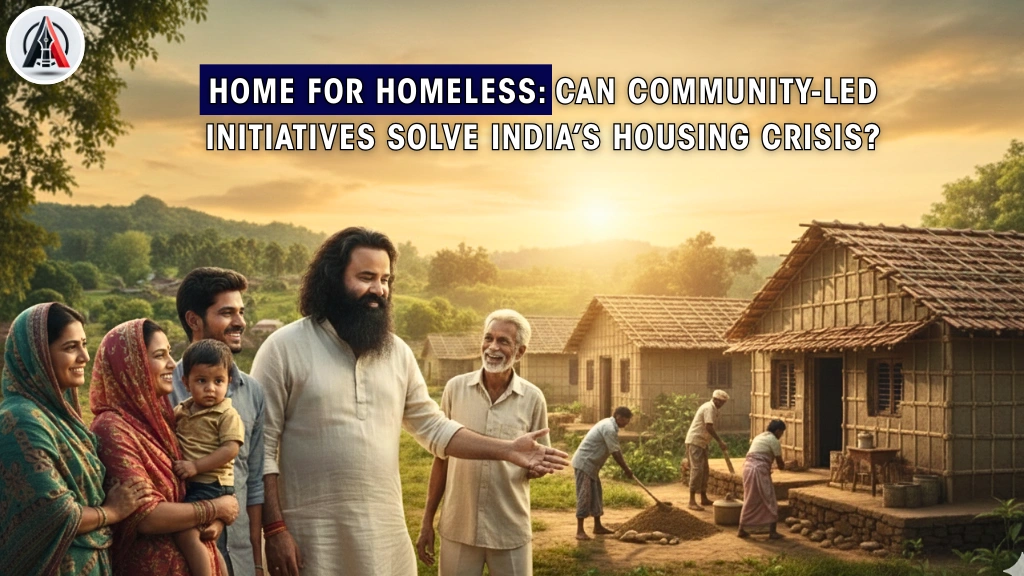
What makes this campaign unique isn’t just that they are building houses, but how they are doing it. In most NGO models, a donor gives money, and a contractor builds the house. Here, the process is driven by what they call “Shramdaan” (voluntary labor).
- Identification: Local volunteer units identify the most desperate cases—widows, orphans, or the destitute who have no other way to build a home.
- Funding: The money for bricks, cement, and steel is collected through small, local contributions from the community itself.
- The Build: This is the most striking part. Instead of hiring workers, hundreds of volunteers gather at the site. Because there are so many hands on deck, a basic house is often completed in just 24 to 48 hours.
By removing the cost of labor (which is usually 30-40% of a construction budget), the community’s money goes much further.
III. On-Ground Impact: Stories from the Field
In states like Haryana, Rajasthan, and Punjab, these houses are now visible symbols of community effort.
Take the case of a family in a small village near Sirsa. For years, they lived in a hut where the roof leaked every time it rained. Last year, local volunteers arrived with materials. In less than two days, they had a brick house with a solid roof and a proper door. For the family, this wasn’t just a gift; it was the first time they felt safe in their own home.
According to reports from the organization, thousands of such houses have been built over the years. While we have to rely on their internal data for the exact numbers, the sheer volume of photos and videos shared by local villagers on platforms like X shows that this is a massive, ongoing effort.
IV. A Balanced View: Community vs. Government
While the “Home for Homeless” campaign is impressive in its speed and volunteer spirit, it is part of a larger ecosystem:
- PMAY (Pradhan Mantri Awas Yojana): Provides financial assistance but requires the beneficiary to manage construction.
- NGOs & CSR: Groups like Habitat for Humanity also work in this space but often rely on corporate funding.
The Comparison: What sets this campaign apart is the “No Labor Cost” model. Because the labor is donated by volunteers (Sadh Sangat), the cost of construction is slashed by nearly 40-50%, making the funds go much further.
V. Conclusion: Can This Be Scaled?
At the end of the day, a house is more than just four walls. It provides the stability a child needs to study, the safety a woman needs to sleep, and the dignity an elderly person deserves.
The Home for Homeless campaign shows that when people decide to work together, they can solve problems that seem too big for any one person to handle. Whether it is through a religious group, a local NGO, or a government office, every effort to put a roof over a head is a step in the right direction.
FAQs:
What exactly is the Home for Homeless campaign? It is a social welfare initiative where volunteers build permanent brick houses for the destitute, widows, and families living in extreme poverty who cannot afford their own shelter.
How are these houses funded? The funding comes from voluntary donations within the Dera Sacha Sauda community. There is no cost to the beneficiary (the person receiving the house).
Who does the actual building work? The construction is done by volunteers who donate their labor. This includes professional masons and laborers who are part of the organization’s welfare wing.
In which states is this campaign active? While it is most prominent in Haryana, Punjab, and Rajasthan, the campaign has reportedly built houses in several other states across India where local volunteer units are active.
How is it different from government housing schemes? Unlike government schemes that provide financial subsidies, this is a community-driven model where the organization provides both the materials and the labor, often completing the house much faster.
What do you think? Should more communities take up the responsibility of building homes for their neighbors? Let us know your thoughts in the comments.
[Disclaimer: The details in this article are based on information provided by organization reports and trending social media updates. This article serves as a social impact explainer and is not an advertisement for any particular organization.]
Blog written by Digvijay Basu, Social Impact Analyst , Kolkata, 20.12.2025
Note: As per the best practices, the blog was edited & structured by ArticoliNews Media tech