

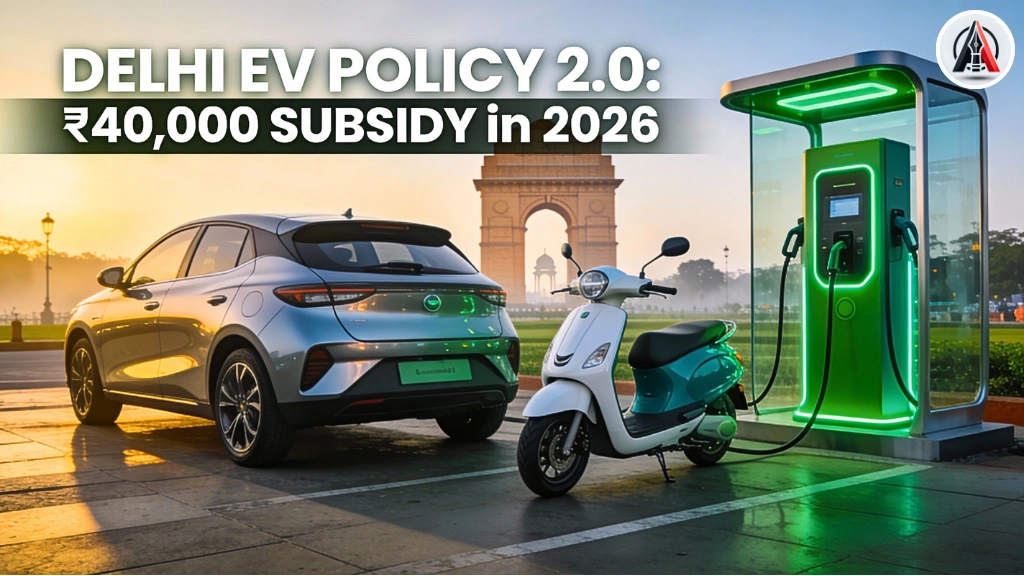
Written by Debraj Paul, Founder and Writer for articolinews.com, 28.12.25
As the founder of articolinews.com, I’ve kept a close watch on the evolution of our capital’s transport landscape. We’ve seen the highs and lows of the 2020 framework, but as we stand at the threshold of a new year, the buzz in the Delhi Secretariat is undeniable. My name is Debraj Paul, and today I’m breaking down the most significant shift in urban mobility we’ve seen yet: the official rollout of the Delhi EV Policy 2.0.
If you’ve been waiting to make the switch to electric, 2026 is officially the year to do it.
📌 Content:
-
The New Year Reset: Delhi EV Policy 2.0 Launch Date
-
The Big Numbers: ₹40,000 EV Subsidy Delhi & Car Incentives
-
The 2026 Innovation: Retrofitting Petrol Car to Electric Subsidy
-
Scrappage Strategy: Delhi EV Scrappage Policy Benefits
-
Charging Infrastructure in Delhi Residential Areas
-
Bullet Point Savings: How Subsidies Change the Math
-
Conclusion
-
Frequently Asked Questions
1. The “New Year” Reset: Delhi EV Policy 2.0 Launch Date
As we enter January 2026, the Delhi Government is replacing the old 2020 framework with the much-anticipated Delhi EV Policy 2.0. For car buyers and daily commuters, this isn’t just a routine policy update; it’s a total financial game-changer designed to battle the city’s chronic air pollution.
Following the cabinet’s decision led by Chief Minister Rekha Gupta, the Delhi EV Policy 2.0 launch date is set for the first week of January 2026. While the previous policy was extended until March to ensure a smooth transition, the new incentives under Delhi EV Policy 2.0 2026 are designed to be immediate, ensuring there is no gap for citizens looking to buy cleaner vehicles in the new year.
2. The Big Numbers: ₹40,000 EV Subsidy Delhi and Car Incentives
The heart of this policy lies in making electric vehicles affordable for the middle class. Under the Delhi EV Policy 2.0, the government has significantly bumped up the cash in your pocket.
-
Delhi EV Policy 2.0 Two Wheelers: For the first time, we are seeing a massive jump in support. Individuals switching from petrol to electric scooters or bikes can now avail a ₹40,000 EV subsidy Delhi (up from the previous ₹30,000 cap). For women buyers, this incentive is even more accessible, aimed at making green mobility inclusive.
-
Electric Cars: If you are eyeing a four-wheeler, the news is equally good. The government continues the total waiver of Road Tax and Registration Fees, saving you anywhere between ₹1.5 Lakh to ₹3 Lakh. Furthermore, for private electric cars priced below ₹25 Lakh, a fresh purchase incentive of ₹10,000 per kWh (capped at ₹1 Lakh) is being reintroduced for the first 27,000 registrations.
3. The 2026 Innovation: Retrofitting Petrol Car to Electric Subsidy
One of the most talked-about features of Delhi EV Policy 2.0 2026 is the push for “recycling” our existing fleet. Instead of forcing you to buy a brand-new car, the government is introducing a retrofitting petrol car to electric subsidy.
If you own a petrol or diesel car priced under ₹20 Lakh that is still in good structural shape, you can now receive an incentive of up to ₹50,000 to swap your engine for an electric powertrain. This is a first-of-its-kind move in India, allowing residents to keep their beloved vehicles while complying with the city’s strict emission norms.
4. Scrappage: The Delhi EV Scrappage Policy Benefits
We all know the pain of the NGT rules: 10 years for diesel and 15 years for petrol. To ease this transition, the Delhi EV scrappage policy benefits have been doubled.
Under this “Double Benefit” strategy, owners who scrap their old, polluting vehicles through authorized dealers will receive an additional financial bonus of ₹10,000 to ₹20,000 on top of the scrap value. This bonus can be directly adjusted against the purchase of your new EV, making the electric vehicle subsidies in Delhi 2026 the most aggressive we’ve ever seen.
[You must know more “Tax reforms at the Center plus subsidies in Delhi” create a perfect buying window.]
5. The Charging Revolution: Charging Infrastructure in Delhi Residential Areas
Range anxiety is the biggest hurdle for most buyers. To solve this, Chief Minister Rekha Gupta has set a clear goal: “Charging your car should be as easy as charging a mobile phone.”
The plan involves installing 5,000 public charging stations by 2030, but the immediate focus for 2026 is charging infrastructure in Delhi residential areas. The government is mandating charging points in all new residential colonies and providing a single-window clearance for RWAs (Resident Welfare Associations) to install community chargers. This means you won’t have to hunt for a station; your “fuel” will be waiting for you in your own parking lot.
6. 📝 Bullet Point Savings: How Subsidies Change the Math
As a founder who looks at the bottom line, I wanted to provide an comparison list that shows you exactly how much you save:
-
Electric Scooters (e.g., Ola, TVS, Ather): Your upfront cost is reduced by up to ₹40,000 through the direct state subsidy.
-
Mid-Range EV Cars (e.g., Tata Nexon EV, MG ZS EV): Expect total savings of ₹1.8 Lakh to ₹2.5 Lakh when combining road tax waivers and registration fee exemptions.
-
Retrofitting Kits: Owners of mid-range cars can get a ₹50,000 incentive to convert to electric.
-
Scrappage Bonus: Get an additional ₹10,000–₹20,000 discount when trading in your “de-registered” petrol or diesel vehicle.
-
Interest Subvention: Commercial buyers and gig workers get a 5% interest rate cut on EV loans, making the EMI much lighter.
As example:
1. Ola S1 Pro (Gen 3)
-
Old On-Road Price: Approx. ₹1,56,000 (with limited subsidies).
-
New On-Road Price (2026): Approx. ₹1,16,000.
-
The Difference: A direct saving of ₹40,000 thanks to the new Delhi EV Policy 2.0 flat subsidy for two-wheelers.
2. TVS iQube (3.4 kWh Variant)
-
Old On-Road Price: Approx. ₹1,42,000.
-
New On-Road Price (2026): Approx. ₹1,02,000.
-
The Difference: The ₹40,000 EV subsidy Delhi brings this premium family scooter down to the price of a petrol Activa, making it a “no-brainer” for FY26 buyers.
3. Ather 450X (2.9 kWh)
-
Old On-Road Price: Approx. ₹1,58,000.
-
New On-Road Price (2026): Approx. ₹1,18,000.
-
The Difference: Aside from the ₹40,000 cash back, buyers also benefit from the continued 100% waiver on registration and road tax, which is a hidden saving of another ₹8,000–₹10,000.
7. conclusion
The Delhi EV Policy 2.0 is more than just a list of rebates; it is a roadmap for a cleaner, quieter Delhi. By focusing on the middle class through the ₹40,000 EV subsidy Delhi and fixing the infrastructure at the grassroots level, the government is removing every excuse to stay with petrol. Whether you are looking at Delhi EV Policy 2.0 two wheelers for your daily commute or a family car, 2026 is the time to make the switch.
8. Frequently Asked Questions (FAQs)
What is the focus of Delhi EV Policy 2.0? The primary focus of Delhi EV Policy 2.0 is affordability and infrastructure, specifically targeting two-wheelers and residential charging.
How much is the subsidy for electric scooters in 2026? Under the new policy, the Delhi EV Policy 2.0 two wheelers segment offers a subsidy of up to ₹40,000, which is higher than the previous ₹30,000 cap.
Can I convert my old petrol car to electric? Yes! A major highlight of Delhi EV Policy 2.0 2026 is the retrofitting of petrol cars to electric subsidy, which offers up to ₹50,000 for the conversion.
When does the Delhi EV Policy 2.0 launch? The Delhi EV Policy 2.0 launch date is expected in the first week of January 2026, with implementation starting immediately to replace the 2020 policy.
Will I get money for scrapping my old car? Yes, the Delhi EV scrappage policy benefits include a financial bonus of ₹10,000 to ₹20,000 when you scrap an old ICE vehicle and purchase a new EV.
Note: As per the best practices, the blog has edited & structured by ArticoliNews Media tech