

Written by Arun Basu on 27.12.2025, AI engineer and writer on articolinews.com
As an AI engineer who spends most of my time looking at code and system architectures, I’ve seen the hype around artificial intelligence come and go. But looking at AI in 2026, things feel different. We are moving past the “chatbot” phase and into a world where AI actually does the work for us.
My name is Arun Basu, and as a writer for articolinews.com, I’ve spent the last few months analyzing the roadmap for the coming year. This isn’t just about robots; it’s about how your doctor, your kid’s teacher, and even your favorite brands will change.
Content List
-
The Rise of Agentic AI in Healthcare
-
Education: The End of One-Size-Fits-All Learning
-
Marketing: Navigating a World Without Cookies
-
Professional Tools: AI in AutoCAD 2026
-
Legal Milestones: The EU AI Act 2026
-
Must-Attend AI Conferences in 2026
-
Conclusion
- Frequently Asked Questions
1. Healthcare: The Rise of Agentic AI
In 2025, we were impressed that AI could summarize medical notes. For AI in 2026, the focus is shifting to “Agentic AI.” These aren’t just programs you talk to; they are autonomous agents that can act.
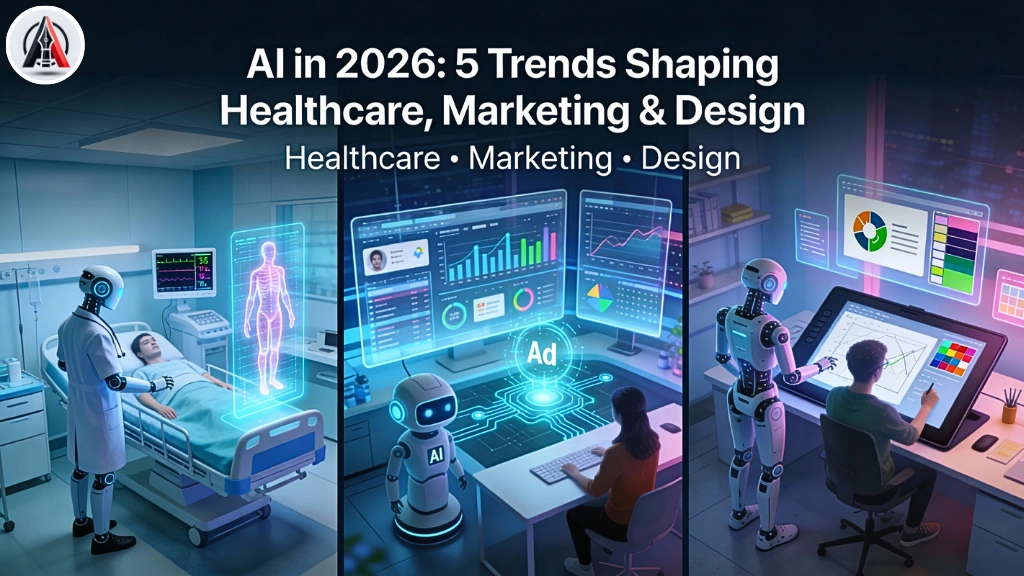
Instead of a doctor manually checking every chart, an AI agent will monitor patient data streams in real time. It can predict a “patient crash” hours before it happens or autonomously schedule a follow-up surgery based on lab results. These AI in 2026 predictions suggest that hospitals will function more like high-tech command centers where the AI handles the logistics, leaving doctors to focus solely on the patient.
2. Education: Your 1-on-1 Personalized Tutor
We’ve moved past students using AI to “cheat” on essays. The big change for artificial intelligence in 2026 is hyper-personalization. Think of it as a lifelong tutor that knows exactly how you learn.
In 2026, educational platforms will use “learning paths” that adapt every second. If a student is struggling with a math concept, the AI won’t just give the answer; it will change its teaching style, perhaps using a visual simulation or a sports analogy, to make it click. This is a massive part of the AI in 2026 landscape: moving from generic tools to personal mentors.
3. Marketing: Moving Beyond the “Cookie”
For years, marketers tracked you with cookies. But with new privacy laws, that’s ending. In response, AI in 2026 will rely on predictive analytics and first-party data.
Brands will use AI to understand what you might want next without ever knowing your personal name or tracking you across the web. This is part of the “Generative Engine Optimization” (GEO) trend. Marketers are no longer just trying to rank on a Google search list; they are trying to be the answer that an AI model gives you when you ask for a product recommendation.
4. Specialized Design: AI in AutoCAD 2026
As an engineer, I have to mention the tools we use daily. One of the most practical examples of AI in AutoCAD 2026 is the “Smart Blocks” feature.
AutoCAD is now using machine learning to look at your past designs and suggest where to place objects. It can find and replace thousands of blocks instantly, saving hours of manual drafting. The artificial intelligence in 2026 integrated into software like this makes the difference between a project taking a week and taking a single afternoon.
5. Legal Milestones: The EU AI Act August 2026
You can’t talk about AI in 2026 without talking about the law. August 2026 is a huge deadline. This is when the EU AI Act‘s rules for “high-risk” AI systems become fully enforceable.
Any company using AI for things like hiring, credit scoring, or medical diagnostics will have to prove their systems are fair, transparent, and have human oversight. This will set a global standard, much like the GDPR did for privacy. If you are building or using artificial intelligence in 2026, you need to be ready for these audits.
6. Planning Ahead: AI Conferences in 2026
If you want to stay ahead of these trends, you should keep an eye on these major AI conferences in 2026:
- AAAI-26: January 20–27, 2026, Singapore (focus on core AI research).
- Global AI Show: February 9–10, 2026, Riyadh (focus on business implementation)
- India AI Impact Summit: February 2026 in New Delhi (focus on social good and scale).
- NVIDIA GTC: March 16–19, 2026, San Jose (the biggest stage for AI hardware and software).
- ICLR 2026: April 23–27, 2026, Rio de Janeiro (deep learning and representation).
Conclusion
Looking back at my notes for AI in 2026, the message is clear: the technology is becoming invisible. It’s no longer a separate “tool” we use; it’s baked into our doctors’ offices, our children’s schools, and our professional design software. Whether it’s the autonomous agents in healthcare or the new features of AI in AutoCAD 2026, we are entering an era where AI doesn’t just talk, it acts.
Frequently Asked Questions (FAQs)
What is the biggest shift for AI in 2026?
The biggest shift is “Agentic AI”—moving from AI that answers questions to AI “agents” that can autonomously plan and complete tasks across different systems.
Is AI in 2026 going to be more regulated?
Yes. The EU AI Act becomes fully enforceable for high-risk systems in August 2026, which will force companies to be much more transparent about how their AI works.
How will AI in 2026 change marketing?
Marketing will move away from tracking users with cookies and toward “Predictive Analytics” and GEO (Generative Engine Optimization), focusing on being the top choice in AI-generated answers.
What are some must-attend AI conferences in 2026?
Key events include NVIDIA GTC in San Jose, the India AI Impact Summit in New Delhi, and AAAI in Singapore.
Note: As per the best practices, the blog has edited & structured by ArticoliNews Media tech