

By Debraj Paul, Founder of Paul Global Ventures & ArticoliNews Media-Tech Co., Kolkata, 10.04.2026.
As a founder involved in export trading and metal markets, my fascination with gold is both professional and personal. Since childhood, I’ve always had a keen interest in gold. Because gold isn’t just a commodity in our country; it is a legacy. I have always looked at gold history through two lenses: its undeniable data-driven growth and its deep-rooted cultural legacy in our homes. Whether it is a business hedge or a family tradition, gold remains the most trusted asset in the Indian psyche. Today, I want to share my knowledge and thoughts on why this “Yellow Metal” remains the heartbeat of India’s economy.
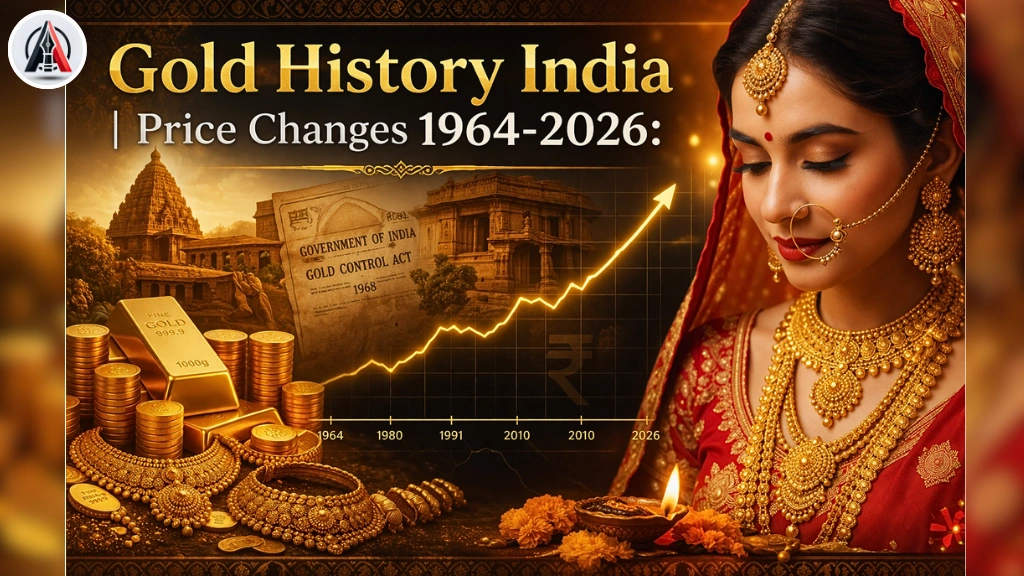
We are seeing numbers today that we never thought possible. But to understand why we are paying over ₹1.5 lakh for 10 grams in 2026, we have to look back at the gold history in India. This isn’t just a financial report; it’s the story of India’s heartbeat. From the ₹63 price tag in 1964 to the massive volatility we are seeing right now, let’s look at the gold history in India: price changes from 1964 to 2026.
🧭 Content Highlights
- Gold History India: The 60-Year Price Evolution
- Full Yearly Price Table (1964–2026)
- Analysis of Crisis Spikes: What Drives the Surge?
- The 2026 Reality: Why Prices Are Skyrocketing Now
- Cultural Roots: More Than Just an Investment
- Conclusion: The Future of Gold in India
- Expert FAQs: Gold Rate & History
1. Gold History India: The 60-Year Price Evolution
If you spoke to your grandparents in 1964, they would tell you that 10 grams of gold cost less than a single movie ticket does today. In 1964, the gold rate was a mere ₹63.25.
By April 2026, that price has climbed to a staggering ₹1,53,000. This evolution represents a growth of over 240,000%. This journey wasn’t just about inflation; it was about India’s transformation from a closed economy to a global powerhouse. Every decade added a new layer to the gold history, making it the ultimate protector of Indian wealth.
You may have a look at the Gold Contract Act 1968.
2. Full Yearly Price Table (1964–2026)
Below is the definitive gold history chart India detailing the average annual price for 10 grams of 24K gold.
| Year | Price (₹/10g) | Year | Price (₹/10g) | Year | Price (₹/10g) |
|---|---|---|---|---|---|
| 1964 | 63.25 | 1985 | 2,130 | 2006 | 8,400 |
| 1965 | 71.75 | 1986 | 2,140 | 2007 | 9,428 |
| 1966 | 83.75 | 1987 | 2,570 | 2008 | 12,361 |
| 1967 | 102.50 | 1988 | 3,130 | 2009 | 15,417 |
| 1968 | 162.00 | 1989 | 3,140 | 2010 | 18,448 |
| 1969 | 176.00 | 1990 | 3,200 | 2011 | 24,130 |
| 1970 | 184.00 | 1991 | 3,466 | 2012 | 29,926 |
| 1971 | 193.00 | 1992 | 4,334 | 2013 | 28,848 |
| 1972 | 202.00 | 1993 | 4,140 | 2014 | 27,708 |
| 1973 | 278.50 | 1994 | 4,598 | 2015 | 26,671 |
| 1974 | 506.00 | 1995 | 4,680 | 2016 | 30,128 |
| 1975 | 540.00 | 1996 | 5,160 | 2017 | 29,174 |
| 1976 | 432.00 | 1997 | 4,725 | 2018 | 30,692 |
| 1977 | 486.00 | 1998 | 4,045 | 2019 | 35,154 |
| 1978 | 685.00 | 1999 | 4,234 | 2020 | 47,562 |
| 1979 | 937.00 | 2000 | 4,400 | 2021 | 47,437 |
| 1980 | 1,330 | 2001 | 4,300 | 2022 | 51,249 |
| 1981 | 1,670 | 2002 | 4,990 | 2023 | 58,836 |
| 1982 | 1,645 | 2003 | 5,600 | 2024 | 64,070 |
| 1983 | 1,800 | 2004 | 5,850 | 2025 | 82,450 |
| 1984 | 1,970 | 2005 | 7,000 | 2026* | 159,000 |
Note: These are approximated prices, but mostly near actual historical averages. Source: Compiled from multiple historical datasets (Groww, BankBazaar, ClearTax, etc.). *2026 = current/estimated average based on ongoing market data.
3. Analysis of Crisis Spikes: What Drives the Surge?
Gold doesn’t just grow; it reacts. Looking back at the gold history, three major events stand out as the primary drivers of these price explosions:
-
1991 Economic Liberalization: India faced a severe balance of payments crisis, leading to the devaluation of the Rupee. As the currency weakened, the gold price in India skyrocketed because gold is a global asset priced in dollars.
-
The 2008 Financial Crisis: When global banks failed, trust in paper money vanished. Investors rushed to gold as a “Safe Haven,” leading to a nearly 320% jump in that decade.
-
The 2020 COVID-19 Uncertainty: The pandemic proved that when the world stops, gold continues to shine. Supply chain disruptions and massive stimulus spending triggered a modern-day gold rush.
4. The 2026 Reality: Why Prices Are Skyrocketing Now
In early 2026, we saw the gold rate touch an all-time high of ₹1,80,000 in January before stabilizing. Why is this happening now?
- Global Inflation: As the cost of living rises globally, investors use gold to preserve their purchasing power.
- Geopolitical Tensions: Ongoing conflicts in the Middle East and Eastern Europe make gold the preferred asset for central banks.
- RBI Reserves: The Reserve Bank of India has been aggressively increasing its gold reserves to safeguard our economy against a volatile US dollar.
5. Cultural Roots: More Than Just an Investment
In India, we don’t just “own” gold; we “honor” it. Our gold history is thousands of years old.
- Vedic Heritage: Gold is known as ‘Swarna,’ representing the sun and fertility. In the Rigveda, it is described as the most pure metal, which is why it is essential for Diwali and Akshaya Tritiya.
- The Wedding Ecosystem: Gold is synonymous with ‘Sreedhanam,’ the wealth a woman carries as her personal security. In 2026, the Indian wedding is a multi-billion-dollar industry where gold is the main character. From the heavy “Rani Haar” to simple wedding bands, it is the ultimate insurance policy for every Indian family.
🛒 Tools to Help You Track Your Gold
- Professional Gold Karat Tester: Shop on Amazon at best price
- Gold Investment for Beginners Book: You may shop on Amazon.
6. Conclusion: The Future of Gold in India
Whether the price is ₹63 or ₹1,53,000, the Indian sentiment remains the same: Gold is Trust. As a founder in the media-tech space, I see gold as the bridge between our ancient past and our high-tech future. While “Digital Gold” is gaining traction, the physical possession of gold will always remain the gold standard of safety in India.
7. Expert FAQs: Gold Rate & History
Q: Why was gold so cheap in 1964?
A: In 1964, the Gold Control Act was in effect, restricting private trading. Additionally, the Indian Rupee had much higher domestic purchasing power before the major devaluations of later decades.
Q: Is it too late to buy gold at ₹1.5 Lakh?
A: According to gold history, gold is a long-term asset. While the price may feel high, it is a hedge against future inflation. For long-term goals like weddings or retirement, any time is a good time for a small, consistent investment.
Q: What is the difference between 22K and 24K?
A: 24K is 99.9% pure gold, ideal for investment (coins/bars). 22K is mixed with alloys for strength, making it the standard for durable, wearable jewelry.
Disclaimer: This blog is for educational and informational purposes only. I am sharing my personal thoughts & expertise as a market enthusiast. Please consult a financial advisor before making significant investments.
Blog written by Debraj Paul, Founder of Paul Global Ventures & ArticoliNews Media-Tech Co., Kolkata, 10.04.2026.
Note: As per the best practices, the blog has been edited & structured by ArticoliNews Media Tech. If you also want to write an article & want to post your blog or article & share your thoughts & knowledge on a public platform to gain an audience, have a look at “How to Become a Writer in 2026: The Ultimate Roadmap.”