

By Robin Mehra: Writer at Articoli News, Blog edited 12.02.2026
I am Robin, an electronics engineer based here in Bangalore. I’ve spent the last few years watching our 5G towers go up across the Outer Ring Road. But today, in early 2026, the real excitement in my lab isn’t about 5G anymore. We are now officially in the “Standardization Phase” of 6G connectivity.
In our profession, we don’t just chase the hype. We look at the hardware and the ethics. As we move toward 6G connecting a cyber-physical world, the goal is to make our cities work for us, not the other way around. Below is the engineering roadmap I’ve put together for the next four years.
🧭 Content List: 6G Smart City Evolution
- Section 1: Network as a Sensor, Seeing Without Cameras
- Section 2: Agentic AI 6G – The Self-Healing Urban Core
- Section 3: Terahertz Urban Infrastructure & Smart Mirrors
- Section 4: 6G Real-World Use Cases (2026-2030)
- Section 5: The 6G Network Launch Timeline
- Section 6: Articoli’s Ethical Engineering Promise
- Conclusion & Engineer’s FAQs
1. Network as a Sensor: High-Fidelity Urban Awareness
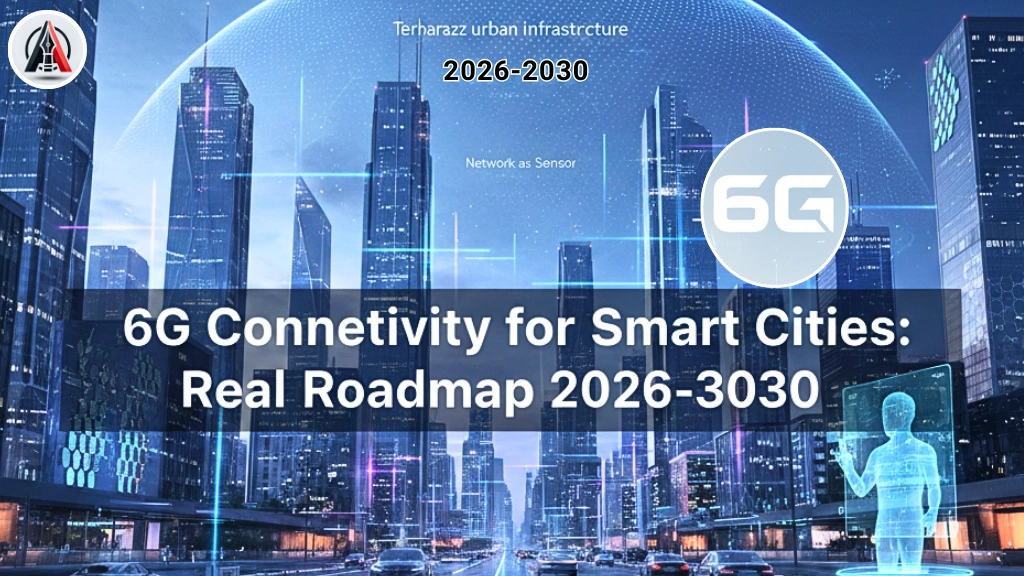
In my line of work, we call this Integrated Sensing and Communication (ISAC). The most practical shift in 6G connectivity is that the radio waves themselves act as a radar. We are essentially turning the Network as a sensor to understand the physical world.
Instead of mounting thousands of cameras on every street light in Bangalore, 6G connectivity uses radio reflections to detect objects.
- Centimeter Precision: The network can “see” a cyclist hidden behind a bus or detect a water leak underground by analyzing signal disruptions.
- Privacy by Design: Since we use radio waves instead of visual optics, we can manage traffic and safety without ever recording a person’s face.
2. Agentic AI 6G: Moving Toward a Self-Healing City
We are currently seeing the integration of agentic AI 6G into the core network. Unlike the basic automation we saw in 5G, agentic AI 6G refers to autonomous software “agents” that make real-time engineering decisions.
In a 6G connectivity framework, if a massive storm hits a city’s power grid, these AI agents don’t wait for a human engineer’s command. They autonomously reroute data through satellite links and prioritize emergency services. This is how we achieve 6G connecting a cyber-physical world, where the digital brain of the city responds to physical crises instantly.
3. Terahertz Urban Infrastructure: The Smart Mirror Solution
One major engineering hurdle we face is that 6G uses the Terahertz spectrum. These waves are incredibly fast but can’t even pass through a piece of plywood, let alone a concrete building.
To make 6g connectivity viable, we are deploying Terahertz urban infrastructure that includes Reconfigurable Intelligent Surfaces (RIS).
- Smart Mirrors: These are low-power panels placed on buildings that “catch” a 6G signal and reflect it around a corner.
- Eliminating Dead Zones: In a dense city, these panels ensure that your connection doesn’t drop just because you walked behind a skyscraper.
4. 6G Real-World Use Cases: Beyond the Smartphone
While everyone talks about speed, I’m interested in the 6G real-world use cases that actually change lives. In our current 2026 pilots, we are seeing:
- Holographic Triage: Paramedics using 6G to beam a high-def 3D hologram of a patient to a surgeon while the ambulance is still in traffic.
- Zero-Latency Grids: Synchronizing thousands of electric vehicle chargers across a city to prevent grid collapse during peak hours.
These 6G real-world use cases prove that 6G connectivity is a tool for resilience, not just faster video streaming.
5. The 6G Network Launch: 2026-2030 Timeline
If you’re wondering when you’ll actually see a 6G icon on your phone, here is the realistic engineering schedule for the 6G network launch:
| Year | Milestone | Focus |
| 2026 | Standardization Begins | ITU & 3GPP define the technical “rules” for 6G. |
| 2027 | Hardware Prototyping | Early terahertz urban infrastructure testing in tech hubs. |
| 2028 | Urban Pilot Programs | First large-scale 6G connectivity tests in cities like Bangalore and Seoul. |
| 2030 | Commercial Launch | Widespread 6G network launch for consumers and industry. |
6. Articoli’s Perspective: Engineering with Discipline
At Articoli News, my philosophy is “Discipline over Drama.” We don’t hype up 6G to sell phones. We analyze 6g connectivity because it is the backbone of an ethical, transparent society.
As we build this 6g connecting a cyber physical world, Articoli ensures that the engineers and writers explaining these shifts are fairly compensated. We believe that if you provide the expertise to explain agentic AI 6G, you should own the value of that insight.
Conclusion: The Living Infrastructure
By the time we hit the full 6G network launch in 2030, our cities won’t just be “connected”—they will be “aware.” 6G connectivity is turning the cold concrete of our streets into a living, sensing, and self-healing fabric.
Whether it’s through the Network as a sensor protecting our streets or agentic AI 6G managing our energy, the roadmap is clear. We are moving from a world where we use tech, to a world where tech is the environment we live in.
As an engineer, I’m curious: does the idea of “camera-less sensing” make you feel safer or more concerned about privacy? Let’s talk in the comments.
❓FAQs: 6G Connectivity in 2026
When is the actual 6G network launch date?
While research started years ago, the first commercial 6G network launch is targeted for 2030. 2026 is the critical year when we decide the technical standards.
How does the “network as a sensor” work without cameras?
It works via radio wave reflection. 6G connectivity uses very high frequencies that bounce off objects (like people or cars). By measuring how long those waves take to return, the network creates a 3D map of the environment.
Will 6G connectivity replace Wi-Fi?
Unlikely. 6G and Wi-Fi 8 (which we are also seeing in 2026) will work together. 6G will handle the massive terahertz urban infrastructure outdoors, while next-gen Wi-Fi handles the short-range indoor links.
Blog written by Mr. Robin Mehra, Bangalore, India. Blog edited 12.02.2026
Note: As per the best practices, the blog has been edited & structured by ArticoliNews Media tech. If you also want to write article & want to post on a public platform to gain an audience, have a look at “How to Become a Writer in 2026: The Ultimate Roadmap”